

HYPERSPIM ERC-AdG WEBSITE

Degree-of-polarization modulation for high-dimensional optical computing
Nature (2026-08-12) https://doi.org/10.1038/s41586-026-10891-z
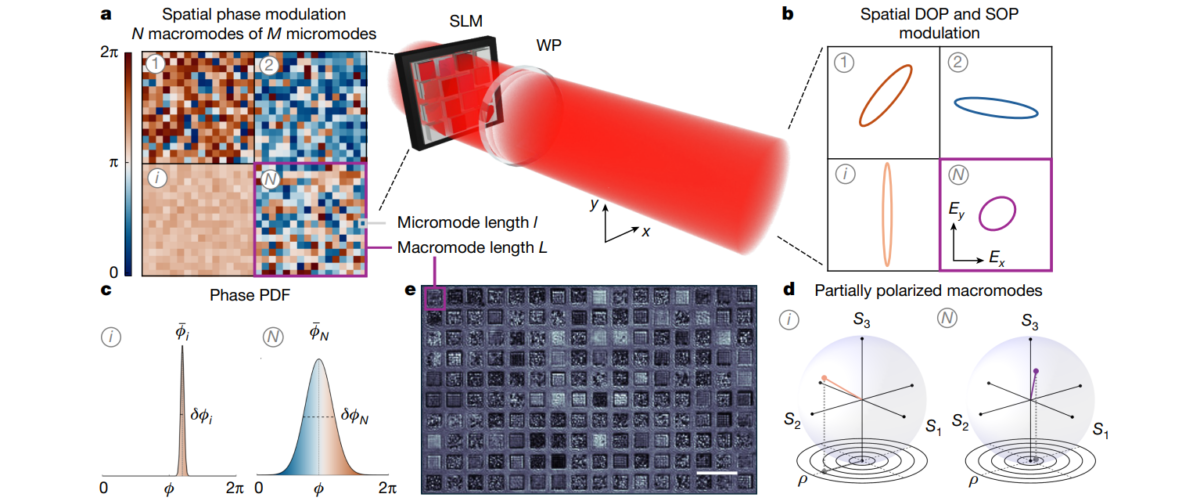
Spatial light modulation is a cornerstone of modern photonics. Crucial advances in photonic information processing rely on the spatial manipulation of the optical phase and state of polarization (SOP). The degree of polarization (DOP) is a fundamental property that can serve as an extra resource. However, no technology exists at present that can spatially modulate the DOP in a programmable manner. Here we demonstrate spatial DOP modulation, thereby achieving control over a new degree of freedom of light. By engineering the polarization statistics at the micrometre scale with a phase-only spatial light modulator, we realize more than 1,024 spatial
modes with fully programmable SOP and DOP. This structured light, sculpted in its polarization content to arbitrary shapes, enables direct encoding of information in a high-dimensional space. We encode colour images into a single-wavelength laser by using a one-to-one mapping between the red–green–blue space and the volume of the
Poincaré sphere. Polarization colours expand the dimensionality of optical computing and encryption schemes, as demonstrated by (1) fully parallel photonic classification of colour images by a high-dimensional photonic neural network and (2) high-security multidimensional optical encryption. These approaches to optical processing of high-dimensional data highlight the opportunities enabled by DOP modulation in photonics, cryptography and computing.
Optical Spin Glasses

https://opg.optica.org/aop/abstract.cfm?URI=aop-18-2-421
Spin-glass theory emerged in the 1980s as a merger between theoretical physics and condensed matter. Soon, physicists realized that spin glasses serve as a paradigm for complex systems, as underscored by the 2021 Nobel Prize in Physics, and for applications in machine learning and neuroscience, with a profound connection with the Hopfield model and Boltzmann machines, subjects of the 2024 Nobel Prize in Physics. However, the connection with optics and photonics is even more profound and fundamental; this connection was identified as early as 1982, with the first realizations of optical neural networks. Thirty years later, the first experimental demonstration of a pillar of spin-glass theory, the replica symmetry breaking, was reported in photonics. Nowadays, many scientists consider photonics as an effective solution for new hardware in artificial intelligence, capable of reducing energy consumption in training large machine-learning modules, and also more suitable for realizing fully connected models that underpin modern data-driven analysis. The substantial equivalence between linear optical propagation and a system of interacting binary spins is now well recognized, triggering the development of a new family of devices for both classical and quantum computing. This review is intended to detail the work of the past twenty years concerning the link between spin-glass theory and optics. After a simple introduction to the main ideas of spin glasses, we start from the first works aimed at finding a direct experimental proof of ideas such as the landscape and ultrametricity; then we report on “linear optical spin glasses,” which refer to the photonic simulation of various Ising models for combinatorial optimization and interlinked with quantum computers; finally, we discuss the emerging field of “nonlinear optical spin glasses,” driven by the impressive progress in the realization of coherent Ising machines with parametric oscillators, that opened an new research direction driven by the cross-fertilization of advanced theoretical physics, artificial intelligence, classical and quantum nonlinear optics.
Observation of Lump Solitons — after 50 years
https://doi.org/10.1103/ggbs-y21w
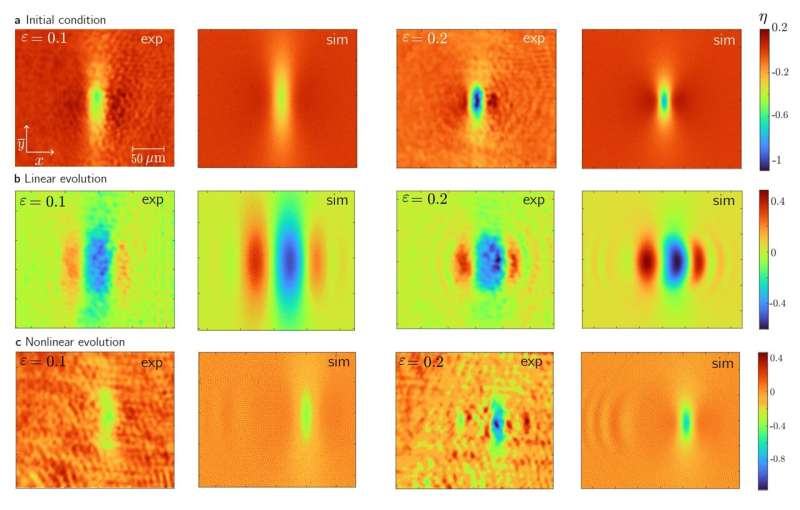
Solitons are the cornerstone of nonlinear physics. The integrability of nonlinear equations is the basis of this universal concept. However, most multidimensional systems lack integrability, a fundamental limitation that challenges the existence of solitons in high dimensions. A remarkable exception would be the lump soliton, a two-dimensional solution of the Kadomtsev-Petviashvili (KP) equation with the unique property of propagating unperturbed in three-dimensional space. Due to the difficulty of implementing the KP dynamics in any physical system, lump solitons have never been observed. Here, we report the first experimental observation of the lump soliton. The lump is realized in nonlinear optics, in a photorefractive crystal under the action of paraxial diffraction and defocusing nonlinearity, ruled by the (2+1)D nonlinear Schrödinger (NLS) equation. We tailor the input field shape and the nonlinearity to realize the hydrodynamic KP integrable regime of the NLS equation. The lump emerges as a self-localized wave that propagates unaltered with a transverse velocity. We confirm its integrable nature by reporting, for the first time, the elastic collision of lumps in two dimensions. As the first experimental evidence of integrable solitons in high dimensions, our observation paves the way for a new era in the study of nonlinear systems.
Featured in Physics, Editors’suggestion
https://physics.aps.org/articles/v19/s22
https://phys.org/news/2026-01-physicists-resilient-3d-solitons-lab.html
Realistic prospects for testing a relativistic local quantum measurement inequality
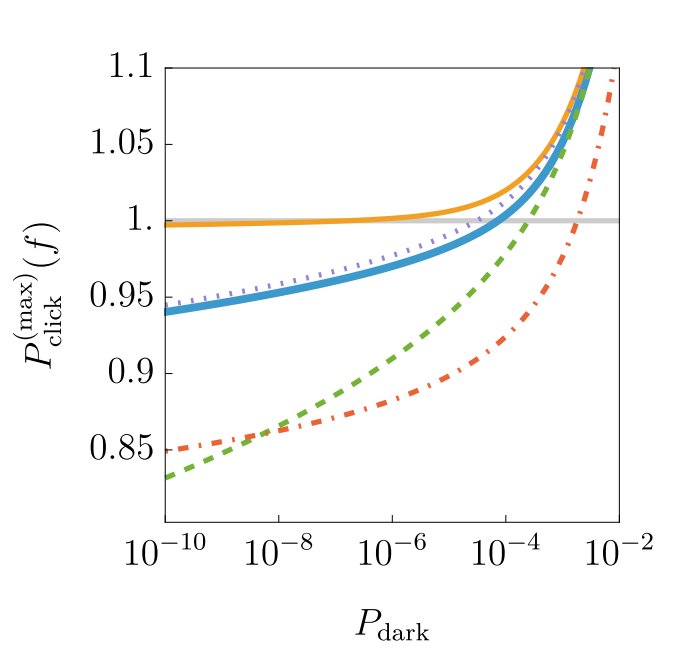
We investigate the experimental prospects for testing a relativistic local quantum measurement inequality that quantifies the trade-off between vacuum insensitivity and responsiveness to excitations for finite-size detectors. Building on the Reeh–Schlieder approximation for coherent states, we derive an explicit and practically applicable bound for arbitrary coherent states. To connect with realistic photodetection scenarios, we model the detection region as a square prism operating over a finite time window and consider a normally incident single-mode coherent state. Numerical results exhibit the expected qualitative behavior: suppressing dark counts necessarily tightens the achievable click probability.